
Based on materials from the Kremenchuk Gazette.
An Idea Years in the Making
Starting next week, Kremenchuk will see the opening of the Adaptation Centre for adolescents with disabilities, catering to those aged 12 to 20. On the eve of the launch, a journalist from the Kremenchuk Gazette spoke with Alla Zhmerenetska—the woman who has been the driving force behind this project.
The Centre was established through the non-governmental organisation “Inclusion Without Limits.” The NGO has a long-standing presence in the community, already operating a specialised kindergarten for children with disabilities. This new Centre will function as a subsidiary branch, continuing their vital mission.

A Personal Mission: From Devotion to Action
Alla herself is raising twin sons, one of whom is a teenager with a disability. She vividly recalls being by his side 24/7. It was only as they grew older that Danylo’s brother, Nikita, began stepping in to support her. Crucially, he knew exactly how to provide the care his brother needed.
Amidst these responsibilities, Alla managed to return to her studies; she is now just one year away from qualifying as a rehabilitation specialist. To gain practical experience, she volunteered at the Kremenchuk Regional Clinical Hospital for War Veterans.
“I went to Mykola Mykolaiovych [the Director] and said, ‘If you need an extra pair of hands, I will do whatever is required.’ I ended up with an incredible team. I miss them dearly, I visit them often—I simply love them,” she shares.
The Birth of a Vision
The idea for the Adaptation Centre was a dream she had nurtured for years. Alla recalls that in 2022, just before the full-scale invasion, she and Kateryna Kunavina (another mother of a child with a disability) organised a charity event titled Christmas for Children with Disabilities. At the time, they planned to establish a centre, but the war made it impossible.
Kateryna was forced to move abroad with her son, where she now tirelessly supports the Centre by seeking out sponsors and international aid. Meanwhile, Alla took on the immense responsibility at home. She even invested her own savings to get the project off the ground, ensuring all lease agreements and official documents were in order.
Her primary motivator remains her son, Danylo. Her goal is to help him adapt to society and provide the vital support he needs right now, during his crucial teenage years. In many ways, he was the “blueprint” around which this entire Centre was built.

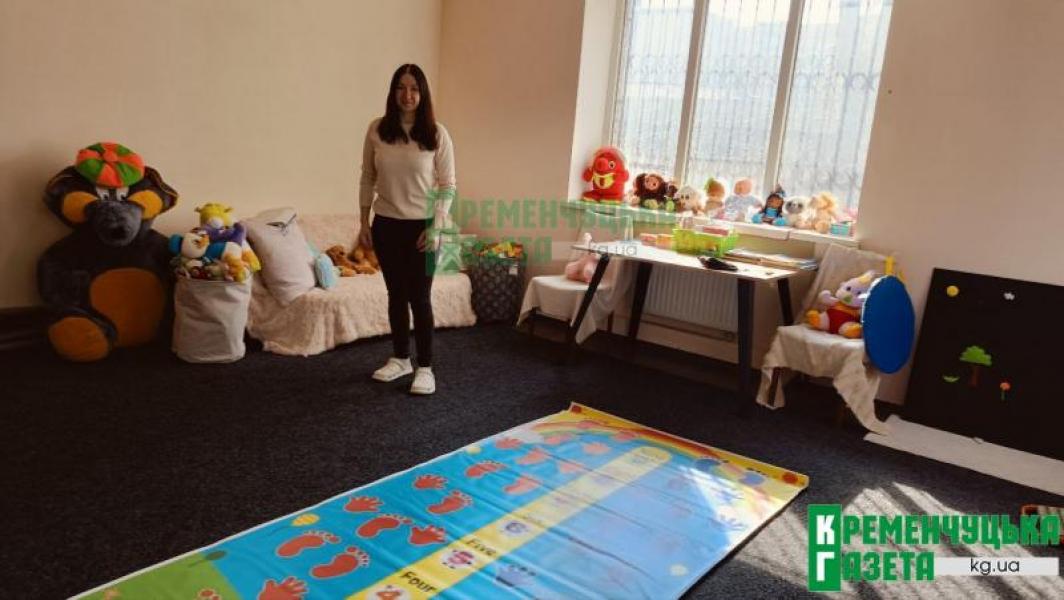
Alla Zhmerenetska greeted us in a room bathed in light from two large windows. She calls it her “Sun Room.” A sofa sits in the corner, while the shelves are neatly lined with toys and educational games.
“This is where sessions will take place for children with complex needs—those who are non-verbal and cannot speak. In some cases, we support children over the age of 12 who still require nappies, and we will continue to care for them as they grow. Our children include those with autism, Down’s syndrome, genetic disorders, and musculoskeletal disabilities. Simply put, these are children for whom there is currently nothing else available in our city,” Alla explains.
She points out that while there are associations where children can attend clubs with their parents or visit the theatre, a gap remains. “Kremenchuk lacks a facility that can take them in for even three or four hours without their parents. This is the void we are filling.”
Alla clarifies that the Centre is also designed to support young adults over the age of 18, as the city’s Municipal Comprehensive Rehabilitation Centre only provides services until they reach that age.
“We have Oksana, who is over 30, and others in their twenties. Our Centre is small; it will cater to just 24 children, with three in each room. We plan to run sessions in two shifts so that parents have enough time to bring their children after they finish at special educational schools. For instance, we have a girl named Oleksandra who needs to attend in the morning because the afternoons are psychologically very taxing for her. We will take the individual needs of every single child into account.”

As we spoke, the sun streamed into the room, making it literally glow. This room is conveniently located on the ground floor, ensuring full wheelchair accessibility. In fact, one of the wheelchairs was donated by Mykola Lytvynenko, the head of the Kremenchuk Regional Clinical Hospital.
Music lessons will also be held in this space. Alla mentions that they have already found a music teacher, Viktoriia—a displaced person from the Luhansk region. She has extensive experience working with children with disabilities and currently serves as a teaching assistant at Gymnasium No. 2.

She also shows an array of instruments—everything from maracas to tambourines and xylophones. What’s more, there will be ten drums used during the lessons!
“We will be trying to draw sounds out of the children. Perhaps through melody, we can encourage their verbal development,” she says.
Only a few weeks ago, the Centre’s premises consisted of nothing but bare walls and a single sofa. Alla cleaned it herself, just as she did with everything else. Her husband built the shelving units for the toys. In fact, almost everything here has been done by hand.
Alla also points out a large screen covered in black fabric, designed for creating changing visual displays. She sews the individual pieces—trees, suns, flowers—herself. She hopes they might even be able to create their own animations. Among the other treasures in the “Sun Room” are plastic containers filled with seeds, such as wheat and maize, for sensory play.

“We still need some beans. We plan to pour them into large tubs for the children to walk through. Soon, we’ll also be installing a ball pit—a gift from a friend of mine who is visiting from Germany,” she shared.
When creating the Centre, safety was a top priority:
- All cabinets are equipped with safety locks.
- Windows are fitted with security bars or specialized locks where necessary.
- The area surrounding the building is fully fenced and secure.
The facility is well-equipped for comfort and hygiene, featuring individual bathrooms for each room and two shower rooms. Additionally, a radiation-proof shelter is located within short walking distance.

The second room for sessions has already been nicknamed the “office” due to the large table that occupies the space. At the moment, there is a desperate shortage of chairs (so if anyone has any to spare, the Centre would be very grateful to receive them).
Recently, the well-known Kremenchuk activist Maryna Orlova delivered soft beanbags and has kindly offered to provide paintings to decorate the walls.

Trampolines and gifts for the first meeting with the teenagers were donated by the well-known Kremenchuk volunteer Artem Marchenko. Despite this, Alla envisions the room being furnished with soft armchairs and hanging egg chairs. It is striking just how many developmental games are kept here. A schedule for upcoming sessions is already displayed on the wall, currently including 16 teenagers.

Next, Alla Zhmerenetska shows us the kitchen. This area will serve as the Centre’s “independent living laboratory”.
“This is our primary, core mission. We will be preparing meals here and learning how to cook. Children who struggle even to hold a spoon will practice doing so here. We also plan to hold workshops,” she explains. These masterclasses are intended not only for the children but for their parents as well.

However, the primary focus is on providing respite: while the children are engaged at the Centre, their parents are free to tend to their own affairs. They can go shopping, visit a doctor, or simply take a well-deserved rest. The Centre is conveniently located in the heart of Kremenchuk, just a short walk from Prydniprovskyi Park.
On the first floor, there is a room perfectly suited for group activities. Plans are already in place to host therapeutic exercise sessions (LFT) for parents, as well as dance classes for the students. This space will also be used for massage therapy; Alla is a certified massage therapist herself, having completed specialised courses and trained under an expert.
Looking Ahead
By spring, the Centre aims to host a fair in the courtyard. Before then, the children will be busy growing flower seedlings.
“We will start by nurturing the seedlings and then transplanting them into pots. We’ll organise a fair downstairs where they will be sold for a symbolic price. This will help the children adjust to social environments and allow them to experience earning their very first income,” Alla explains.
The Centre is also open to hosting fundraising fairs for the Armed Forces of Ukraine, as the spacious courtyard is ideal for such events. In tandem with this, Alla is currently searching for a potter’s wheel to introduce pottery and clay-working sessions.
The Face of the Centre
Special mention must be made of the Centre’s administrator, Mykhailo—a role offered to a young man with Down’s syndrome.
“I truly want him to be our administrator and the face of our Centre. He will greet our guests, open the doors, help welcome the children, and see them out to their parents. He will handle all the responsibilities of a professional administrator. He is very reliable, and I sincerely hope everything works out for him,” says Alla.
A Dream for the Future
Alla shares that her ultimate dream is to acquire a vehicle so the students and their families can go on excursions and trips to nature. However, such a vehicle must be fully wheelchair-accessible. Throughout our conversation, Alla mentioned several times that she finds it difficult to ask for help. She noted that she hasn’t approached the Kremenchuk municipal authorities yet, as the Centre is intended to serve children not only from the city but from the surrounding communities as well.

“I am reaching out for support from patrons. I have already contacted the Poltava Regional Administration and am awaiting their response. Yesterday, I received a call from the assistant to Oleksandr Bilenkyi, the Chairman of the Regional Council. He is aware of our Centre. I would dearly love to meet with him to show everything we have achieved in these last few weeks. In fact, I have invited him, his deputy, and the head of the legal department—we would be glad to welcome them all,” Alla says.
Kind-hearted people are appearing, and help is coming from where it is needed most. Alla Zhmerenetska notes that the entrepreneur Dmytrychenko helped create a specialised developmental mat (allowing the Centre to now pursue other ideas) which is quite costly. Support is also flowing in from the family of Kremenchuk District Council Deputy Dmytro Kolotiievskyi, from the mothers of children with disabilities, and from specialists across Ukraine.
In tandem with these efforts, she is preparing grant applications to secure funding, stating that she is seizing every possible opportunity. She remains open and ready for collaboration with patrons and sponsors.
Meanwhile, the first meeting with parents and children has already taken place, and the Centre’s work is set to begin in just a few days.
By Olena Liposhko
Photos by the author